 Login
Login 
Will AI Replace Graphic Designers? An ALX Instructor Weighs In
- 02 Jun 2026
The debate tends to go in circles. AI is killing design. AI is saving design. Junior designers are finished. Senior designers are safe. Everyone has a take, and most of them are loud.
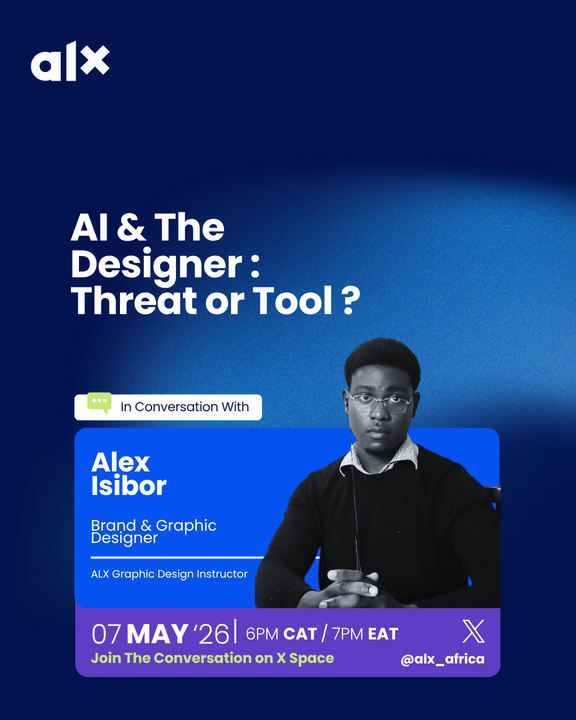
Alex Izibor has a quieter one, and seven years of real design work behind it.
Alex is a professional brand and graphic designer and a graphic design technical instructor at ALX. When he first encountered what tools like Midjourney could produce, his reaction surprised even himself. "My first thought was: this is going to make design so much easier." No panic. No defensiveness. Just a designer who had already watched his tools evolve more than once, and knew what that usually meant: more opportunity, not less.
That instinct runs through everything Alex says about AI. It comes not from naivety, but from watching the industry long enough to recognise a pattern. Every time the tools shift, the designers who move with them pull ahead. The ones who dig in and resist get left behind, not by machines, but by other people.
Where AI Tools for Graphic Designers Actually Help
Alex is careful not to make AI sound like a magic fix. He ran into its limits firsthand on a brand identity project, a passion project where he needed a truly specific concept, something with its own feel. He tried using AI to help him ideate. What came back was generic. Technically competent, but hollow.
"It just kept giving me the same stuff. This is not the unique mind I'm looking for."
He ended up doing the research himself, drawing from other designers' work, sitting with the problem until the right direction emerged. No tool did that thinking for him.
That experience shapes how he uses AI day-to-day. He leans on it for the smaller, adjustable things: tweaking a hue, generating a colour variation with specific hex codes, getting a quick visual approximation of something he already has in mind. Tasks where the decision is already made and he just needs execution. "If it's accurate enough, it works. I wouldn't hold myself back simply because it's AI."
But the moment AI starts doing the thinking, choosing the concept, the typography, the direction, the entire rationale for a design, that is where Alex steps back. His reasoning is clear: "At that point, you've lost your identity as a designer." The tool should be working for you. The second you flip that, you have a different problem entirely.

Are Entry-Level Design Jobs at Risk from AI?
The harder question came from the audience: isn't the "AI is just a tool" argument easier to make when you already have the experience, the clients, and the years? Can a junior designer say the same thing?
Alex sat with that for a moment.
His answer was that the design job market is actually growing, but with a catch. As AI tools become more capable, fewer designers are willing to learn them properly. The ones who do develop a genuine edge. Clients and contractors want speed and quality, and AI can enable both, but only in the hands of someone who understands design principles well enough to direct it. An entry-level designer who can work fluently with current tools, while still bringing their own thinking, walks into rooms that were harder to access a few years ago.
What they have to avoid is the opposite trap: treating AI as the designer and themselves as the person typing prompts. "You can easily be replaced as well," Alex said plainly. "Because you have no identity. You lose your identity as your own designer."
The risk runs in both directions. Fear the tools and you get left behind. Surrender to them entirely and you become interchangeable.
What Graphic Designers Should Do About AI Right Now
If you are anxious, learn the tools. Not as a way of coping, but as a genuine skill. Understand what they can and cannot do. Use them to speed up the parts of your work that do not require your particular way of seeing things. Protect the parts that do.
Alex has watched older designers refuse to budge on this, experienced people who know their craft but will not move with the moment. He sees that as an opening for younger designers who are willing to adapt. The industry will keep evolving. It always has.
"The demand is only going to continue to rise," he said, "because only a handful of people will be willing to evolve with those tools."
Seven years in, Alex Izibor is one of them, and he is not planning to stop. ALX's Graphic Design programme is built around instructors like Alex, working professionals who are still active in the industry. If you are thinking about making the move into design, that is a good place to start.
In case you missed it live, listen back to the X Space conversation here: